Monday, September 19, 2016

Orphans of Freedmen in Apprentice Records 1866 Jefferson County, Mississippi

"Mississippi Probate Records, 1781-1930," images, FamilySearch (https://familysearch.org/pal:/MM9.3.1/TH-1961-30945-427-6?cc=2036959 : 21 May 2014), Jefferson > Minutes 1862-1870 > image 184 of 440; county courthouses and public libraries, Mississippi.


My friend and colleague, Annette Bowen found some interesting documents that tell a story of African American children being apprenticed within months of emancipation.  Here is her note to me.

Nick,
I was looking through Jefferson County Mississippi Probate Court Minutes for the year 1866 and stumbled upon numerous items referring to apprenticing children.  Many of the applications gave the age and birthday.  Most of the children seemed to be "freedmen" so I assume they were children of slaves, newly freed.  Most said they were orphans but a few said their mothers had given approval.  Some specified that they would learn a trade like blacksmith, but most didn't.  Girls were apprenticed to age 18 and boys until age 21.  I don't remember seeing these before and thought you might be interested.  
Annette 
Indeed I am interested!  Thank you Annette!

Here is one of the URLs that have apprenticeships. You need to be signed in to Family Search for the links to work.

The above URL is in regard to the matter of the apprenticeship of Leonard Hamilton and John W. Martin, Orphans of Freedmen. Here are some key excerpts of the record:

Leonard Hamilton was aged sixteen years on the 31st day of December A.D. 1866 and John W. Martin aged thirteen years on the 31st day of December 1866.    
[Since the day is the same, this does not appear to be a birthday rather it is a statement of their age at the time of apprenticeship.]
H. B. McClure will teach or cause to be taught to each of the said orphans the Blacksmith's trade and that he will at the expiration of terms of Apprenticeship pay to the said Leonard the sum of one hundred dollars and the said John W. the sum of two hundred dollars and pay to each the sum of twenty dollars per year

Matilda Wilkes is also mentioned as the orphan of Freedmen on the same page.

Attempts to locate Leonard Hamilton born about 1850 in Jefferson County, Mississippi in the 1870 census using full name, last name only and first name only were unsuccessful.

Attempts to locate John W. Martin born about 1853 in Jefferson County, Mississippi in the 1870 census using full name, last name only and first name only were also unsuccessful.

H. B. McClure was also not found in Jefferson County, Mississippi in 1870.  But I did find a blacksmith named James McClure in the 1870 census and on FindaGrave.com:

Birth: May 28, 1822
Death: Nov. 17, 1891
Buried: Fayette Cemetery, Jefferson County Mississippi
Find A Grave Memorial# 46624479
Home in 1870: Township 9, Jefferson, Mississippi
Ancestry.com Image: 29 of 119

He had apprentices residing with him in 1870 but they were all white.


The above URL mentions the following persons:

Anna Darden to apprentice:

Patsy Bell, 12 years old
Henry Bell, 9 years old
Caroline [no last name] 12 years old

Anna Darden was found in the 1870 census of Jefferson County, Mississippi but the young black people that were listed near her did not have names in the census.
The above URL mentions the following persons:

Mrs. H.M. Griffin to apprentice:
Delia Griffing born Nov 12, 1852
Rose Griffing born June 3, 1858
Addison Griffing born May 29, 1856
Ann Harrison born July 17 1853
Harry Harrison born May 28 1857

Mrs. H.M. Griffing was  found in the 1870 census as follows:

Name: [Mrs.] H M Griffing
Age in 1870: 53
Birth Year: abt 1817
Birthplace: Mississippi
Home in 1870:  Township 9, Jefferson, Mississippi
Race: White
Gender: Female
Post Office: Fayette
Value of real estate: View image
Household Members:
Name Age
John J Griffing 62
H M Griffing 53
Jacob Herring 26
Anna Herring 17

There were several black families listed near the Griffings and the Herrings.  The similarity of the names Herring and Harrington are notable.

There is an eighteen year old black male named Addison Bruin? on line 27 of the previous page of the census.

I have heard of this apprenticeship process occurring in other localities.  This could be a great opportunity to uncover more buried records on African Americans in the reconstruction period.


Monday, September 5, 2016

Georgetown Offers Truth, Reconciliation and Reunion to Slave Descendants


On September 1, 2016 John J. DeGioia, president of Georgetown University, said that it would apologize for its history with slaves and that their descendants would get admissions priority.  His offer to the descendants fell short of the request for a scholarship fund from many descendants but a process has been put in place to continue the dialogue about further steps.  It was a shock to many that a university operated by Jesuit priests owned slaves.  Even more startling was the revelation that Georgetown priests sold 272 slaves to plantation owners in Louisiana in 1838 to provide funds to get the University out of debt.

I was intrigued when I heard the announcement so I decided to dig a little deeper into the background story.  If you would like to read more about it, I recommend the following links:

The genesis of this apology was a family history project! A woman hired a professional genealogist to learn about her Louisiana ancestors.  “My Goal Was Just to Tell My Story” Profile of Patricia Bayonne-Johnson, descendant of one of the Georgetown slaves.

The full text of President DeGioia's message can be found here.

April 2016 NY Times article regarding Georgetown's search for slave descendants

May 2016 NY Times article which profiled several of the Georgetown slave descendants included this comment: "I Have A Million Questions for My Ancestors Now" 

September 2016 Article on Slate: How Do Descendants of Slaves Find Their Ancestors?

Georgetown Slavery Archive

The inventory of documents related to slavery at Georgetown.

One page in the Georgetown Slavery Archive Related to Descendants stories that I found particularly interesting.

Some of my unresolved questions are:

  • How will Georgetown offer admission priority to slave descendants? 
  • What level of proof will be required for descendants to become eligible for admission priority?
  • Will there be a searchable database of the Georgetown slave descendants?
  • Will this effort by Georgetown be a model for other institutions to follow?

Here is some summary information extracted from a flyer for a Georgetown Teach-In:


Why were the slaves sold in the 1830s?

In the 1830s, William McSherry and Thomas Mulledy, prominent U.S. Jesuits in their day, judged the
operation of the plantations with slave labor to be an inefficient way to fund the Jesuits’ activities.
Georgetown College was the most expensive and ambitious Jesuit project in this period.

How did the sales transpire?

When Fr. McSherry was head of the U.S. Jesuits and Fr. Mulledy was head of Georgetown College in the mid 1830s, Fr. McSherry authorized several sales of enslaved people in small numbers. Roughly $16,000 (adjusted for inflation: about $400,000) from these sales went into Georgetown’s operating budget. In 1838, Frs. McSherry and Mulledy switched offices, and Fr. Mulledy directed the sale of the remaining slaves. Most of the people were sold to Henry Johnson and his associate Jesse Battey. Mr. Johnson had been a governor of and senator from Louisiana. At the time of the sale, he was a U.S. congressman. He was also the uncle of a Georgetown student.

How much revenue did this sale generate?

The agreed upon price was $115,000. $17,000 (about $500,000 today) of a $25,000 down payment was used to pay down Georgetown’s building debt that had accrued under Fr. Mulledy’s leadership of the College in the earlier years. On account of Mr. Johnson’s own financial difficulties, the Jesuits appear never to have received the full $115,000.

What were some of the terms of the sale?

Jesuits were divided over what to do with the plantations. Officials in Rome had favored freeing the
slaves. Fr. Mulledy and his allies argued that manumission was not feasible or financially responsible. Rome put conditions on the sale of slaves: That families not be separated, that the money not be
used to pay off debt or go to operating expenses, and that provisions be made for the religious practice of the slaves. None of these conditions was met. Aided by a few sympathetic Jesuits, some of the slaves escaped as the sale and transfer were underway.


Monday, August 29, 2016

"It Takes A Village"... in German Genealogy

German genealogy can be extremely fascinating and rewarding.  The importance of finding the name of the place of origin of your German ancestors must be repeated many times.  It is interesting how certain phrases enter the American lexicon such as: "It takes a village..."

According to Wikipedia: It takes a village is a proverb that leverages the cultural context and belief that it takes an entire community to raise a child: A child has the best ability to become a healthy adult if the entire community takes an active role in contributing to the rearing of the child.

I wrote before at this linked phrase about the importance of finding the hometown of our German immigrants. American genealogical sources must be thoroughly researched before attempting to delve into the German church records. It takes the name of a village to find the name of the church.

It also takes a village of genealogists and historians to figure out the name of the village of origin. Case in point is one of my current projects involving a Houston couple, Henry Brenner 1827-1911 and Fredericka Eggert 1828-1901.  The historians at the Washington and Glenwood cemeteries in Houston have been integral residents of this village.  The tangled web of family trees on Ancestry.com has also provided a number of persons that have this couple in their family trees. Fortunately, one of those trees had a document attached that was prepared by the cemetery historians. This report on the Brenner family was a jump start to the process of sorting out the tangled web.

The full German name for Henry Brenner is thought to be Heinrich August Brenner.  The full German name for Fredericka Eggert was originally thought to be Marie Friedericke Eggert.  After further examination of the family trees that had that full name, it appears that they have provided that name based on a record for a person with a similar name as follows:

name:  Marie Friedericke Eggert [possible, but not a strong match;]
gender:               Female
baptism/christening date:    29 Jul 1836
baptism/christening place:  EVANGELISCH,BLASHEIM,WESTFALEN,PRUSSIA
father's name:     Franz Heinrich Eggert
mother's name:   Henriette Cathrine Fincke
indexing project (batch) number:        K98332-5
system origin:     Germany-ODM
source film number:           1050756
reference number:              

The church burial record[1] is translated as follows:
Burial July 22, 1901; Frau Fredericka Brenner nee Egert born 6 Sep 1828 in Steink, Sachsen [Saxony]; died 21 Jul 1901 from Diarrhea; buried in the German Cemetery, Houston [Now Washington Cemetery]

1901 Church Burial Record from German Lutheran Church, Houston, Texas

Based on the birth date in this burial record it appears that many family trees have erred in selecting the name Marie Fredericke and the birth date from 1836.  The record above is from Westphalia.  Fredericka Eggert was born in the vicinity of the state of Saxony from the burial record or Mecklenburg from the 1870 census.

The place of birth given in the 1870 census for Fredericka Eggert Brenner is Mecklenburg, Germany.

1870 Census show Fredericka Eggert with her husband Henry Brenner, children Mina and William and other possible relatives in adjacent households.
Mecklenburg-Vorpommern is a federated state in northern Germany today. The capital city is Schwerin. The state was formed through the merger of the historic regions of Mecklenburg and Vorpommern after the German reunification in 1990.  The states of Mecklenburg-Schwerin and Mecklenburg-Strelitz became Grand Duchies in 1815, and in 1870 they voluntarily joined the new German Empire, while retaining their own internal autonomy.

Google Map showing the current state of Mecklenburg-Vorpommen in area highlighted in pink


The 1901 burial record says that Fredericka Eggert was born in Steink, Saxony.  A review of an online German gazetteer[2] found no match for Steink.  However a wildcard search yields the following possible matches for Steink as a prefix for a place name.  All of these place names are in Niedersachsen, Bundesrepublik Deutschland:

Format: -place name -type -Superordinate objects -postal code –GOVId

·         Steinkamp settlement Seesen, Goslar, D38723; STEAMP_W3370
·         Steinkamp place Groß Oesingen, Gifhorn, D29393; STEAMP_W3121
·         Steinkimmen place; Ganderkesee, Oldenburg, D27777; STEMEN_W2871
·         Steinkirchen municipality; Grünendeich, Stade, D21720; STEHENJO43TN
·         Steinkrug place Wennigsen (Deister), Region Hannover, D30974; STERUG_W3001
·         Steinkrug settlement Boffzen, Boffzen, Holzminden, [no postal code] STERUGJO41QS
·         Steinkuhle settlement Sehnde, Region Hannover, [no postal code]STEHLEJO42XH
·         Steinkuhle settlement Northeim, Northeim, D37154; STEHLE_W3410
·         Steinkuhle settlement Bad Münder, HamelnPyrmont,

Steinkirchen is a municipality near Hamburg as shown on the following map:

Steinkirchen is a municipality near Hamburg in Niedersachsen Bundesrepublik Deutschland.  Note the proximity to Bremen where Henry Brenner was born per 1870 census and Schwerin which is the capital of Mecklenburg-Vorpommern.
If you would like to join my village of German genealogy researchers or if you need any help with your immigrant ancestors, please contact me.


[1] Title: GERMAN LUTHERAN CHURCH (FIRST EVANGELICAL, LATER KNOWN AS CENTRAL CONGREGATIONAL CHURCH) RECORDS, 1851-1966; Church Located in Houston, TX. Records Include: Marriages From 1874-1966, Baptisms From 1851-1959; 1961-1966, Burial/Death Registers From 1881-1966, Communion Register From 1851-1948; 1951, Rosters, Constitution, and Financial. Early Years Records are in German. Different Types of Records are Separated on Various Places on Roll and are Arranged by Date. Roll Filmed Upside Down; Microfilm at Clayton Library, Cabinet 92, Drawer 2; the historians at Glenwood & Washington Cemeteries have a printed version of this record for ready reference.

Monday, August 22, 2016

Genealogy in Your Back Yard- Family History Centers

I started my genealogical research in 1989 while living in Reno, Nevada.  We were fortunate to have a Family History Center in Reno.  I owe much of my early success in genealogy to the use of the FHC that was operated by volunteers from the Church of Jesus Christ of Latter Day Saints.  The director of the center, Tom Sawtelle had retired from the University of Nevada.  He became a mentor to me and I will forever be indebted to him for his encouragement.  Tom also helped me to organize a genealogy class that was offered through the community college.  He allowed me to offer my class at the FHC.

Family History Center, Reno, Nevada


Family History Centers (FHCs) are branches of FamilySearch and the Family History Library in Salt Lake City, located all over the world. Their goal is to provide resources to assist you in the research and study of your genealogy and family history by:

  • Giving personal one-on-one assistance to patrons
  • Providing access to genealogical records through the Internet or microfilm loan program
  • Offering free how-to classes (varies by location)

There are more than 4,700 FHCs in 134 countries. There is no cost to visit a Family History Center or FamilySearch Library. They are open to anyone with an interest in genealogical research. They are operated by The Church of Jesus Christ of Latter-day Saints (LDS).  I have always found the volunteers in these centers to be very knowledgeable.  They share your passion for genealogy and are extremely helpful.

Family History Centers provide free access to many subscription genealogy websites, including:

  • 19th Century British Newspapers
  • Newspaper Archives
  • Alexander Street Press (American Civil War Collections)
  • Ancestry.com (Family History Library Edition)
  • ArkivDigital Online
  • findmypast
  • Fold3.com
  • HeritageQuest Online
  • Historic Map Works (Library Edition)
  • Paper Trail, A Guide to Overland Pioneer Names and Documents
  • WorldVitalRecords.com


You should take the time to visit a Family History Center.  You can search for the nearest facility at this link: https://familysearch.org/locations/ 

I am fortunate to have two Family History Centers close to me: Friendswood and League City.  In addition, the Clayton Library is also a Family Search partner facility that can receive microfilm from Salt Lake City.  Much of the information that we need to fill in the gaps on our family trees is on microfilm and not yet available online.

I was pleased to learn that the League City facility is hosting a special event on September 17, 2016 from 9 am to 3 pm called Rootstech Family Discovery Day.  The details of the event are here:


 This is a free educational event that I encourage you to attend.

Monday, August 15, 2016

Digging Deeper in Cemetery Research

Cemetery research is often similar to an archaeological excavation both literally and figuratively. The events of the past week have helped to crystallize my thinking about the "digging deeper" metaphor.

This is the cover page of the book that I purchased on Saturday.
On Saturday, I attended a presentation about a new Images of America book entitled: Galveston's Broadway Cemeteries.  The author of the book, Kathleen Shanahan Maca has been researching genealogies and cemeteries for over 40 years.  The cemetery on Broadway in Galveston is actually seven separate cemeteries that date back to 1839.  The stories Kathleen told and the images shown were both poignant and amazing.

Most of us have heard about the seawall in Galveston that was constructed after the 1900 hurricane to protect the island from future storms. Many structures that were previously five to six feet above sea level were also raised after the 1900 storm to heights of eight to 22 feet.  Kathleen surprised me when she said that the Galveston burial grounds were also elevated three times between 1918 and 1925. If cemetery lot owners declined the opportunity to assist in these cemetery raising projects, then their cemetery lots could be resold leading to as many as three levels of interments in the Galveston cemeteries. Many of the early cemetery markers were buried and many of the mausoleums were left with only their roofs exposed.

Only an estimated 25 percent of the markers in the Broadway cemeteries have been raised.

Volunteer "digs" at Galveston cemeteries reveal wrought iron fences and original markers that were buried in the process of raising the grade level of the cemeteries.

Some of the plots in the Broadway cemeteries may appear to be an archaeological dig.

Another opportunity to hear Kathleen Shanahan Maca speak is coming up on Friday, September 30, 2016 at the meeting of the Bay Area Genealogical Society. She will discuss her genealogical research process and resources used to uncover the personal stories behind the gravestones.  Meet in the Chapel on the 1st Floor of the University Baptist Church at 6:30 pm for coffee and socializing.  I encourage you to come and pick up an autographed copy of Galveston's Broadway Cemeteries.  The meeting and educational program begins at 7 pm. UBC is located at 16106 Middlebrook Drive,
Houston, TX 77059 (Clear Lake City).


Monday, August 8, 2016

Bootlegger: Cimino Family Legend

Were your ancestors making more than juice and jelly?
Source: Winefolly.com
"Finding the Roots of Your Family Legends" was one of the presentations by D. Joshua Taylor that I attended on Saturday at Rice University.  Josh is one of the hosts of the popular Genealogy Roadshow reality series on PBS.  The end of his seminar was greeted with a standing ovation from the Houston genealogy community.  He recommended that we develop historical context for family legends through newspapers and local history publications.

I am wondering if South Sioux City, Nebraska had a newspaper in the late 1920s or early 1930s.  I am trying to verify a family legend about bootleg wine.  For a few facts about prohibition, check out this link: http://winefolly.com/update/prohibition-facts/

My dad told me a story about his grandfather, Tony Cimino making wine during Prohibition. Enacted in January 1919, the 18th amendment to the U.S. Constitution prohibited the manufacture, sale or transportation of intoxicating liquors. Prohibition lasted from 1920 to 1933.

My great grandfather, Tony Cimino had been making his own wine since he had come to the United States and settled in Omaha, Nebraska in 1909. Tony moved his family to Sioux City, Iowa in 1912 and then across the river to South Sioux City, Nebraska in 1920. According to the story my dad told, Tony decided that it would be wiser not to store the wine in the house any more.  He went out to the field near his house and buried his gallon jugs of wine. Apparently a neighbor must have reported him.  The Sheriff arrived at the house with a team of horses and a plow. 

This event occurred after my Grandpa Dick started working in Sioux City at the packing plant in 1926. In 1930 the Cimino families lived on West Frederick Street in South Sioux City.  My great grandfather's home address changed to  618 West 17th Street but they never moved.  The street name was changed sometime between 1930 and 1940.

The streetcar line from Sioux City, Iowa to South Sioux City, Nebraska was about 5 or 6 blocks from the house.  Tony had apparently buried a lot of jugs because Dick could smell the wine as soon as he got off the streetcar.

According to some sources, home wine making was legal during prohibition but apparently not in Nebraska:

"...in 1916 Nebraska voters approved a statewide prohibition amendment. Prohibition passed in Nebraska almost simultaneously with limited woman suffrage, and with the full support of the Nebraska Woman Suffrage Association. By law, there would be no more booze when the law formally went into effect in 1917."  SOURCE: NebraskaStudies.org

I sent an inquiry to the South Sioux City Library asking if it is possible to borrow their newspaper microfilm through interlibrary loan.  

I also asked if they have any local history books or manuscripts that might include stories about the prohibition period in South Sioux City.

It would really be fun if I could verify this story.

Apparently his bootlegging was not serious enough to prevent him from becoming a citizen in 1930.

1930 Certificate of Citizenship for Tony Cimino, South Sioux City, Nebraska

The Cimino Family first settled in Omaha, Nebraska with other immigrants from Carlentini and Lentini in the Siracusa province of Sicily.  The Omaha newspapers at GenealogyBank.com provide us with this wonderful story of an Omaha winemaker in 1970.


Source: GenealogyBank.com; Date: Sunday, October 18, 1970 Paper: Omaha WorldHerald (Omaha, Nebraska) Page: 30


If you would like help researching your family legends, please contact me.

Monday, August 1, 2016

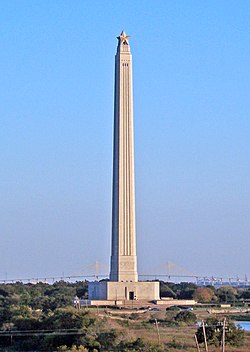
Monumental Genealogy at San Jacinto Battleground


San Jacinto Monument.jpg
A 2006 view of the San Jacinto Monument with the Fred Hartman-Baytown Bridge in the background. This is the view of the monument as it appears from the Battleship Texas which is another attraction of the San Jacinto Battleground State Park
SOURCE: Wikimedia Commons


The battleground that gave birth to the Republic of Texas has been surrounded by an army of refineries and chemical plants.  The monument in the center of the battlefield is a bastion defending genealogical and historical treasures.

View of refineries and chemical plants from the observation deck of the San Jacinto Monument
SOURCE: Nicole Hall
My birthday celebration last Friday seemed like the perfect occasion to visit the monument, the museum and the library in the center of the San Jacinto Battleground State Park.


This aerial captures the beauty of the San Jacinto Battleground State Park
SOURCE: Texas Department of  Parks and Wildlife

A visit to the library requires an advance appointment but it is a simple matter to use the contact information on the website to make arrangements for your visit.  There is only one table available for research. The library floorspace is devoted to bookshelves and file cabinets.

The top of the Library page http://www.sanjacinto-museum.org/Library includes a virtual tour of the Library.
The ceilings of the library are at least fifteen feet high and the walls are packed to the rafters with books. Only one or two researchers can be accommodated at the same time.  The library webpage includes a 360 degree virtual tour that shows the small room and the stacks of books.

The bottom of the Library page http://www.sanjacinto-museum.org/Library
This shows the links to the manuscripts, research procedures and the veterans biographies.

Please examine the website thoroughly before your visit as it contains a wealth of information about the library and includes online biographies of battle veterans.

HISTORICAL EVENT: A mural depicting General Sam Houston and a squad of men during the Battle of San Jacinto has been painted onto an oil storage tank near Beltway 8 along Hwy 225.
This mural depicts General Sam Houston at San Jacinto Battleground on a most unusual canvas. SOURCE: chron.com
I am not sure how we missed them on the way in but a collection of murals can be seen on oil tanks on Independence Parkway and Highway 225.  The murals are most visible as you exit the park.  I found a vast array of oil tank images and articles using the following search terms:  "san jacinto oil tank murals".  These murals are quite impressive and have garnered attention from journalists across the country.

Genealogy Roadshow host, Mary Tedesco revealed a San Jacinto battle veteran to Sarah Lasater on the Houston Episode.

The Houston episode of Genealogy Roadshow includes the discovery of a veteran of the Battle of San Jacinto. I interviewed Sarah Lasater after the filming of the Houston episode and wrote a blog about it here.  The biography for her ancestor, Francis Laster is found here.

For more information on visiting this state historic site visit the website of the Texas Department of Parks and Wildlife.

View of the Battleship Texas from the observation deck of the San Jacinto Monument
SOURCE: Nicole Hall


For more information on the museum and library and to view some of the genealogical treasures go to their website: http://www.sanjacinto-museum.org/